I. Meeting Panel: The "Smart Solution" for Small to Medium-Sized Meeting Rooms
Optimal Scenarios: Small to medium-sized meeting rooms for 10-50 people, executive offices, training rooms, brainstorming rooms.
Core Advantages:
Integrated Smart Experience: Integrates a 4K touchscreen, Android/Windows system, microphone, camera, and speakers; ready to use right out of the box. Supports intelligent writing, annotation, QR code saving, split-screen interaction, and other functions, making it a perfect replacement for traditional whiteboards.
Convenient Wireless Projection: Supports wireless screen sharing from mobile phones, tablets, and laptops, with up to four-screen display, greatly improving meeting efficiency.
Flexible Mobility: Equipped with a floor-standing mobile stand, it can be moved to different rooms or locations as needed.
Main Limitations:
Size Limitation: Currently, the largest commercially available size is approximately 100 inches (approximately 2.2 meters wide x 1.2 meters high). For meeting rooms with more than 30 people and a large depth, viewers in the back rows may not be able to see clearly.
Single Signal Source Limitation: Most entry-level models only support single-channel screen sharing, requiring repeated switching when presenting on multiple devices.
Selection Recommendations: For meeting rooms under 40 square meters that require frequent interactive discussions and brainstorming, a conference flat panel is the best choice. Recommended sizes: 65-75 inches for 10-15 people, 86 inches for 15-25 people, and 98-100 inches for 25-40 people.
II. LCD Video Wall: A Balanced Choice for Medium-Sized Meeting Rooms
Optimal Scenarios: Medium-sized meeting rooms for 30-100 people, multi-functional halls, training rooms, and monitoring centers.
Core Advantages:
Flexible Size Combinations: A single 55-inch LCD panel (approximately 0.8㎡) can be combined into 2×2, 3×3, 2×4, etc., easily achieving a display area of 100-200 inches, with flexible 4K/8K resolution configuration.
Mature and Stable Image Quality: Utilizes industrial-grade LCD panels with a brightness of 400-500 cd/m², high contrast, and true color reproduction, reducing eye strain during extended viewing. Eliminates the pixelation of LED screens, maintaining a sharp image even at close range.
Acceptable seam width: The latest ultra-narrow bezel products achieve a double-sided seam width as low as 0.88mm (approximately half the thickness of a one-yuan coin). Viewed from 3 meters away, the seam's visual interference is minimal.
Main limitations:
Physical seams still exist: Although extremely narrow, a dark line can still be discerned upon close inspection against pure white or light-colored screens. This may not be perfect for scenarios requiring an extremely seamless look (such as high-end brand showrooms).
Professional installation and commissioning: Requires professional splicing brackets, signal distributors, and geometric calibration; the installation cycle is longer than with a conference flat panel.
Selection recommendations: When the conference room size exceeds the coverage of a conference flat panel (greater than 100 inches) and the budget is lower than for LED screens, LCD video walls are the best compromise. For a conference room with around 60 people, a 3×3 (approximately 165 inches) or 2×3 (approximately 110 inches) splicing solution is recommended.
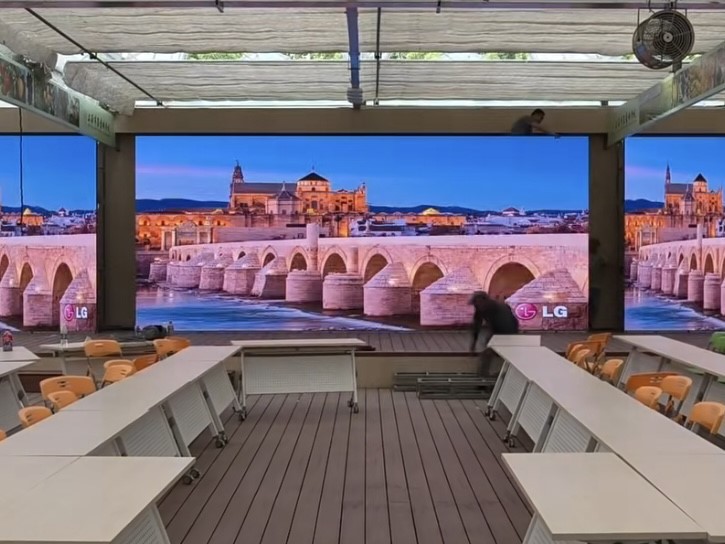
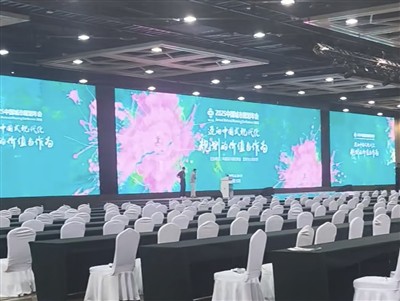
III. LED Display Screens: The "Seamless Giant Screen" for Large Auditoriums
Optimal Scenarios: Large conference rooms, auditoriums, auditoriums, corporate showrooms, and annual meeting stages for 100+ people.
Core Advantages:
Truly Seamless: This is the absolute advantage of LED over LCD splicing screens. No matter how close the viewer, no physical seams or black lines are visible; the image is complete and uniform.
Unlimited Size: Giant screens of tens or even hundreds of meters can be achieved, and the aspect ratio can be customized to 16:9, 2:1, or even 1:2 and other irregular shapes.
Adjustable Brightness: Indoor LED screen brightness ranges from 500-1500 cd/m², adapting to various lighting conditions from dark to bright environments.
Main Limitations:
Graininess at Close Range: If a standard P2.5 or larger pitch is used, pixelation (screen door effect) will be visible when viewed within 4 meters. Smaller pitches (P1.8 and below) are needed to improve this, but the cost increases dramatically.
High Cost: For the same display area, LED screens typically cost 1.5-3 times more than LCD video walls. A 20-square-meter P1.8 screen costs approximately 120,000-200,000 yuan, while an LCD video wall of the same size only costs 60,000-100,000 yuan.
Complex Maintenance: Aging or damage to the LED beads requires professional repair and may result in "dead LEDs" (individual pixels not lighting up).
Selection Recommendation: LED screens should only be considered if the viewing distance from the front row of the conference room is >5 meters, or if the required area is >150 inches and the budget is sufficient. For lecture halls of 100-150 people, P2.5 or P2.0 screens with an area of 25-35 square meters are recommended.