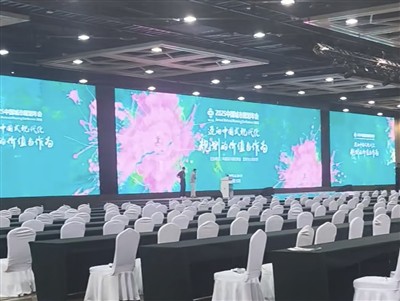
I. Small-Pitch LED Display Screen: The First Choice for Seamless Giant Screens
Technical Features: Small-pitch LEDs are indoor LED products with a pixel pitch of less than P2.5. Inheriting the seamless splicing capability of outdoor LEDs, they can form large screens of any size and proportion through precise cabinet assembly, completely eliminating physical seams. Combined with point-to-point calibration technology, they offer excellent brightness and color consistency, supporting 2K/4K and even 8K displays.
Applicable Scenarios:
Medium-to-large conference rooms (80-200 square meters, 40-100 people): The viewing distance for the front row is typically over 4 meters, where the pixelation of small-pitch LEDs is barely noticeable, fully showcasing their seamless advantage.
Corporate showrooms/lecture halls: High requirements for overall image integrity; no seams or black lines are tolerated.
High-end business reception rooms: Showcasing corporate image and pursuing the ultimate visual experience.
Advantages:
Completely seamless, uniform and unified image.
Unlimited size, customizable aspect ratio.
Adjustable brightness, adaptable to different ambient light conditions.
Disadvantages:
Grainy appearance at close range (<3 meters), requires small-pitch LEDs (P1.5 and below).
Higher cost, especially for products below P1.8.
Risk of dead LEDs exists, requiring regular maintenance.
Selection Recommendation: When the required size exceeds 150 inches, the front-row viewing distance is >4 meters, and the budget is sufficient, prioritize small-pitch LEDs. P2.0 or P2.5 are recommended for their high cost-performance ratio.
II. LCD Video Wall: An Efficient Tool for Multi-Screen Display
Technical Features: LCD video walls consist of multiple 55-inch industrial-grade LCD panels, with a single screen resolution of 1920×1080. Through a video wall controller, multiple signals can be simultaneously displayed, such as a PPT presentation on the main screen, a data dashboard on the secondary screen, and a third channel for remote video conferencing. Supports arbitrary signal switching, picture-in-picture, and roaming functions.
Applicable Scenarios:
Large multi-functional conference rooms (100-200 square meters): Need to simultaneously display multiple information sources, such as head office video conferencing + local PPT + product demonstrations.
Enterprise data monitoring centers: Real-time display of various KPIs and big data dashboards.
Training classrooms: Main screen displays teaching content, side screens display lecturer close-ups or supplementary materials.
Advantages:
Supports simultaneous display of multiple signals, high information density.
High single-screen resolution, sharp image quality even at close range.
Bezel width can be reduced to 0.88mm, with limited visual impact.
Moderate price, high cost-performance ratio.
Disadvantages:
Physical bezels still exist; dark lines are visible under solid color images.
The overall resolution after splicing is the sum of the individual screens, not point-to-point 4K.
Installation and debugging require a professional team; subsequent maintenance is slightly complex.
Selection Recommendations: When you need to simultaneously display multiple information sources, have low requirements for seamlessness, and have a limited budget, LCD video walls are the best choice. A 2×2 (approximately 110 inches) or 3×3 (approximately 165 inches) solution is recommended.
III. Smart Meeting All-in-One Machine: The Interactive Center for Small Meeting Rooms
Technical Features: The smart meeting all-in-one machine integrates a 4K touchscreen, Android/Windows dual system, microphone array, high-definition camera, and speakers, and is ready to use right out of the box. Its core selling point is the integration of display and writing: users can write, annotate, and erase directly on the screen, and it supports scanning QR codes to save meeting minutes. It also supports wireless screen sharing from computers, mobile phones, and tablets, with up to four screens displayed simultaneously.
Suitable Scenarios:
Small meeting rooms (20-80 square meters, 10-30 people): Such as departmental meetings, client negotiations, and brainstorming sessions.
Executive offices: Replaces traditional whiteboards, improving meeting efficiency.
Training institutions: Teachers can directly annotate and explain on the screen, enhancing interactivity.
Advantages:
Highly integrated, eliminating cables and peripherals.
Smooth touch writing, replacing whiteboards.
Convenient and quick wireless projection.
Flexible mobility (floor stand optional).
Disadvantages:
Maximum size is only 100 inches (approximately 2.2m x 1.2m), making it difficult for those in the back rows of a meeting room with more than 30 people to see clearly.
While the price per unit is not high, the cost per unit area is expensive (approximately 30,000-50,000 RMB for a 100-inch screen, equivalent to twice the cost of a P1.5 LED screen).
Does not support multi-screen splicing to expand the size.
Selection Recommendation: When the meeting room area is less than 80 square meters, the number of participants does not exceed 30, and frequent interactive discussions are required, the intelligent conference all-in-one machine is the most suitable choice. Recommended sizes: 65-75 inches for 10-15 people, 86 inches for 15-25 people, and 98-100 inches for 25-30 people.