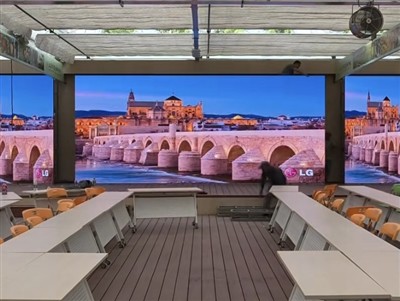
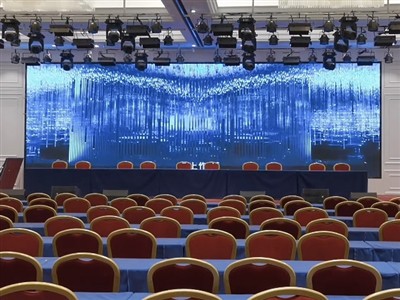
What are the characteristics of a color LED display screen?
I. Advanced Digital Video Processing Technology
The core driving force of a full-color LED display screen lies in its advanced digital video processing system. Behind each display screen is a complex architecture consisting of a sending card, a receiving card, a video processor, and a control system. The video processor can scale, color correct, optimize grayscale, and convert frame rates of various input signals (HDMI, DVI, SDI, Ethernet, etc.), and then transmit them via gigabit network or fiber optic cable to the driver IC on each module, precisely controlling the on/off state and brightness of each LED bead.
High Grayscale Level: Modern full-color LED displays can achieve 16-bit or even higher grayscale, meaning there are more than 65,536 levels of brightness variation from completely off to maximum brightness, resulting in extremely smooth image transitions without any visible color blocks or stripes.
High Refresh Rate: Typically reaching 1920Hz-3840Hz, far exceeding the limits of human visual perception, no black scanning stripes appear when shooting with a camera or mobile phone, making it suitable for television broadcasting and professional videography.
Point-by-point calibration technology: Before leaving the factory or periodically, the brightness and chromaticity of each LED are measured using a professional camera, and calibration coefficients are generated and written to the receiving card to ensure uniform color across the entire screen and eliminate mosaic effects.
II. Unparalleled Large Area and Ultra-high Brightness
The most obvious advantages of color LED displays are their size and brightness.
Large Area: Due to the modular splicing of LED displays, theoretically, any size can be achieved. Sizes range from tens of square meters to thousands of square meters, a feat unattainable by other display technologies such as LCD or projection. For example, a giant LED screen of thousands of square meters can cover the entire facade of a building, becoming a visual focal point in the city.
Ultra-high Brightness: For outdoor environments, the brightness of full-color LED displays can reach 5000-8000 cd/m² or even higher. Even under the strong midday sun in summer, the advertising images remain vibrant, eye-catching, and clearly readable. Indoor displays can have their brightness reduced to below 1000 cd/m² to avoid glare. This wide range of brightness adaptability allows color LED displays to meet the stringent requirements of different environments. III. Flexible Configuration of Illuminated Pixels Based on Environment
Full-color LED displays are not limited to one form. To adapt to different indoor and outdoor environments, viewing distances, and budgets, they employ various specifications of luminous pixels to achieve differentiated brightness, color, and resolution.
Pixel Pitch Determines Resolution: Outdoor displays commonly use specifications such as P4, P5, P6, P8, and P10. A larger pixel pitch results in lower resolution for the same area, but also lower cost, suitable for longer viewing distances. Indoor displays can use smaller pitch products such as P1.2, P1.5, and P2.5 to achieve near-LCD-like image quality.
Diverse Packaging Forms: Outdoor screens use waterproof and UV-resistant SMD (Surface Mount Device) or DIP (Dual In-line Package) LEDs with an IP65 or higher protection rating. Indoor screens often use smaller SMD or COB (Chip-on-Board) technologies, improving reliability and heat dissipation.
Customizable Color Gamut: By selecting LED chips of different wavelengths and combining them with phosphors, the color gamut of the display can be adjusted to meet brand VI colors or specific industry standards.
IV. Comprehensive Support for Dynamic Graphics and Multimedia
Color LED displays are no longer simple "text-scrolling screens." They can dynamically display graphic and animated information and utilize multimedia technology to play various multimedia files in all formats.
Content Format Freedom: Supports playback of MP4, AVI, MOV video files, JPG, PNG images, and real-time text, clock, weather, stock quotes, and other dynamic data.
Screen Splitting: A large screen can be divided into multiple screens to display different content simultaneously-for example, the left side plays the main advertising video, the right side displays real-time news captions, and the bottom is divided into several small windows displaying stock indices or traffic information.
Network Connectivity and Interaction: Remote cluster management and real-time content updates are possible via 4G/5G, Wi-Fi, or fiber optics. Some high-end screens also support interactive functions such as touch, radar sensing, and facial recognition.
V. World-Class Real-World Examples
The most impressive examples of the charm of full-color LED displays are undoubtedly the giant screens that have become city landmarks.
New York Stock Exchange, Times Square, Manhattan: Home to one of the world's most influential LED displays. A total of 18,677,760 LEDs (nearly 18.7 million LEDs) were used, covering an area of 10,736 square feet (approximately 997 square meters). This screen can clearly display Wall Street stock market information, brand advertisements, and more. It is not only an information window but also a symbol of global business vitality.
The Aurora International Headquarters in the Lujiazui Financial Center, Pudong, Shanghai, China: The entire facade facing Puxi is adorned with a 100-meter-long super-large LED screen, covering a total area of 3,600 square meters, once considered the world's largest. Every night, this giant screen, together with the Oriental Pearl Tower and the Shanghai Tower, becomes an unmissable scenic spot on the Bund viewing platform and an ultimate example of corporate brand display.
In conclusion, full-color LED displays, with their digital video processing technology, ultra-large and ultra-bright visual impact, flexible and configurable pixel specifications, comprehensive multimedia support, and numerous world-renowned real-world examples, have become an important visual symbol of modern cities. Whether used for outdoor advertising, sporting events, public information dissemination, stage performances, or commercial real estate, it offers communication value that is difficult for any other display technology to replace. With the continuous maturation of Micro LED and Mini LED technologies, future color displays will be more refined, energy-efficient, and intelligent, and their application boundaries will continue to expand.