The Difference Between Demonstration Screens and LED Screens: A Comprehensive Comparison from Principles to Selection
I. Display Principles: Backlight-Dependent vs. Self-Emitting
This is the most fundamental technological difference between the two.
Demonstration screens (taking LCD as an example) use a backlight system for illumination. Internally, they consist of a multi-layered structure: a backlight source (LED strips or mini-LED backlight) emits white light, which passes through complex optical components such as polarizers, liquid crystal layers, and color filters. The amount of light transmitted to each sub-pixel is adjusted by controlling the twisting angle of the liquid crystal molecules, thus synthesizing an image. The entire process does not involve self-emissive pixels, therefore it suffers from inherent problems such as "light leakage" and "limited contrast." While OLED screens are self-emissive, they are made of organic materials, posing a risk of burn-in and incurring extremely high costs for large sizes.
LED displays are completely different. Each pixel is directly composed of thousands of red, green, and blue LED chips (SMD or COB packaged). The brightness (grayscale level) of each chip is precisely controlled by a driver IC, and the three colors of light are directly mixed to produce the desired color, without any backlight or filters. This pure solid-state self-emissive principle results in higher brightness, purer black levels (black means no light emission), and faster response times.
II. Structural Characteristics: Fixed Bezel vs. Seamless Splicing The demonstration screen is a highly integrated finished product. Mainstream sizes range from 46-98 inches, with fixed physical bezels (approximately 5-10mm for narrow-bezel models). Sizes exceeding 98 inches require splicing multiple units, but regardless of technological improvements, LCD splicing screens always leave noticeable physical seams (approximately 1.7mm-3.5mm), causing a "black line break" phenomenon when displaying continuous images. Furthermore, it integrates a motherboard, power board, logic board, etc., making it a "buy-and-use" all-in-one device.
LED displays employ a modular, building-block design. The smallest unit is the cabinet (e.g., 600×337.5mm), each containing a receiver card, driver IC, and power supply. Through precise mechanical interlocking between cabinets, screens of theoretically any size and aspect ratio (long strip, square, ultra-wide) can be assembled. Through a fine-tuning mechanism, the gaps between the cabinets can be controlled within 0-3mm, making the seams completely invisible to the naked eye and achieving a truly seamless giant screen effect. This flexibility is unmatched by large presentation screens.
III. Application Scenarios: Close-up Precision vs. Long-distance Immersive Experience
Large presentation screens are best suited for small to medium-sized close-up scenarios: corporate conference rooms (10-30 people), principal's offices, training institutions, and home theaters. In these scenarios, the audience is typically 2-5 meters away from the screen, requiring high image detail, color accuracy, and long-term viewing comfort, without needing an extremely large size. The high PPI (pixels per inch) and anti-glare coating of LCD screens perfectly meet these requirements.
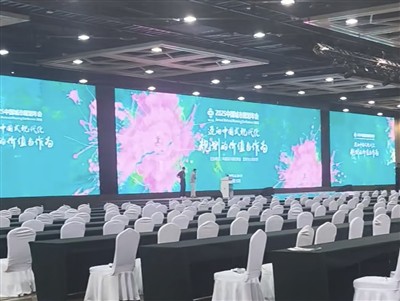
LED screens dominate large-scale long-distance scenarios: large advertising screens in shopping mall atriums, circular screens in stadiums, large lecture halls (over 100 people), and smart city command centers. These scenarios require sufficiently large screen sizes (tens or even hundreds of square meters), seamless seams, high brightness and resistance to ambient light, and viewing distances typically exceeding 5 meters, where the requirement for single-point pixel density is actually lower. Furthermore, only LED screens can achieve outdoor waterproofing, wind resistance, and weather resistance.
IV. Display Effect: Soft and Delicate vs. Bright and Impactful The display characteristics of large-screen presentations are "soft, accurate, and comfortable." The matte coating of LCD screens effectively reduces ambient light reflection, reducing eye strain during prolonged viewing. Their uniform backlighting and fine pixel density result in sharp edges when displaying text and tables, and natural skin tones when showing photos. The disadvantages are a sharp increase in cost for screens larger than 100 inches, and the physical seams of spliced screens can disrupt the integrity of the image when displaying full-screen maps or flowcharts.
LED screens, on the other hand, offer the advantages of "brightness, seamlessness, and dynamic impact." The high brightness (500-1500 nits indoors, 5000+ nits outdoors) from self-illumination makes them vibrant and eye-catching even in strong light. Their seamless nature makes them suitable for displaying ultra-wide data dashboards or immersive backgrounds. However, in indoor scenarios with small pixel pitch, improper brightness adjustment or excessive pixel pitch can cause glare and pixelation when viewed at close range. Furthermore, the color temperature consistency of LED screens requires professional calibration; otherwise, localized areas may appear too cool or too warm.
V. Price Structure: Pricing Method and Cost-Effectiveness
The pricing logic for the two types of equipment is completely different, and directly comparing "price differences" can be misleading.
Demonstration Large Screen: Priced by "unit" or "unit". An 86-inch branded all-in-one LCD monitor (including touch screen, OPS computer, and speakers) costs approximately 15,000-30,000 RMB. Prices increase sharply for screens larger than 100 inches, with home-use products exceeding 110 inches reaching 100,000-500,000 RMB.
LED Display Screen: Priced by "square meter". A P2.5 indoor full-color screen (including cabinet, power supply, receiver card, and control system) costs approximately 3,000-6,000 RMB/㎡. A 100-inch (approximately 2.2m × 1.2m = 2.64㎡) LED screen would cost approximately 8,000-16,000 RMB, cheaper than an all-in-one LCD monitor of the same size. However, to achieve a P1.2 micro-pitch (suitable for viewing within 3 meters), the unit price could rise to 15,000-30,000 yuan/㎡, making it more expensive than LCD for the same size.
Key conclusion: For screens under 100 inches and viewing distances of 2-4 meters, large-screen displays offer superior cost-effectiveness and display quality. For screens exceeding 120 inches, viewing distances above 5 meters, or requiring seamless splicing, the flexibility and overall cost advantages of LED screens become more apparent.