What are the differences between LED and LCD? A thorough explanation from principle to application
When buying TVs, monitors, or outdoor screens, the terms "LED" and "LCD" are often mentioned together, which can be confusing. Many people assume they are completely different screens, even believing that LED is an "upgraded version" of LCD. In reality, in most everyday contexts, LED and LCD are related as one encompassing the other, not as parallel components. To help you clearly understand the essential differences between the two, this article will conduct an in-depth comparison from three core dimensions: light source, display effect, and size limitations.
I. Light Source: Active Light Emission vs. Passive Light Transmission
This is the most fundamental and basic difference between LED and LCD.
LED (Light Emitting Diode): It is a solid-state semiconductor device, with a tiny semiconductor chip at its core (usually made of materials such as gallium nitride and gallium phosphide). When a forward voltage is applied across the LED, electrons and holes recombine in the PN junction region, and the excess energy is released in the form of photons-this is "electro-optical conversion." Simply put, an LED is an active light-emitting element that can directly convert electrical energy into light energy. When powered on, it lights up; when the power is cut off, it goes out. The red power indicator lights, white flashlight bulbs, and the small lights on giant outdoor advertising screens we commonly see are all LEDs.
LCD (Liquid Crystal Display): Its full name is Liquid Crystal Display. Its core material is liquid crystal-an organic compound that exists between a solid and a liquid state. Liquid crystal itself does not emit light at all. The process of displaying an image on an LCD involves three steps: First, a backlight emits white light (early models used CCFL tubes, but now most use white LED strips for backlighting); then, the white light passes through the first polarizer and becomes polarized light; next, the liquid crystal molecules twist under the control of an electric field, like rows of tiny "blinds," determining how much polarized light passes through; finally, each sub-pixel is colored with red, green, and blue through color filters, mixing to form the color image you see. The core conclusion: LCDs are passive display devices; they must rely on a backlight to be seen.
For a direct comparison: you can think of an LED as a "self-illuminating light bulb," while an LCD is a "light switch matrix composed of countless tiny blinds." It doesn't light up on its own and requires someone to provide lighting from behind.
II. Display Effect: Fine Dynamics vs. Coarse Static Displays
Due to their different light-emitting principles, the two exhibit significant differences in their actual performance when displaying images and videos.
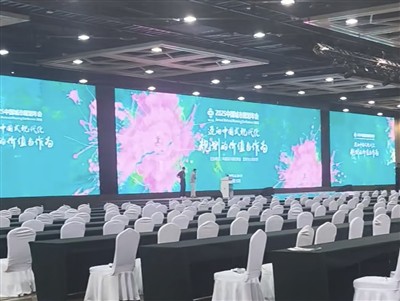
LED Display Characteristics: When LEDs are used to form displays (i.e., LED direct-view displays, commonly found in outdoor billboards and concert backdrops), they are generally more suitable for displaying text, graphics, and large blocks of color. This is because a pixel is composed of one or several LED beads, and there is a certain physical spacing between the beads (e.g., P10 represents a 10mm spacing). At a sufficiently far distance, the overall image is clear; however, upon closer inspection, noticeable graininess (mosaic effect) becomes apparent. Furthermore, LED beads struggle to achieve the smooth transitions of LCDs when displaying fine edges (such as small text or complex icons). Furthermore, LED direct-view displays are rarely used to play high-dynamic-range, high-detail movies or surveillance footage because their color saturation and brightness uniformity are inferior to LCDs when viewed at close range. Of course, small-pitch LEDs (such as P1.2 and P0.9) greatly improve these issues, but the cost increases exponentially.
LCD display characteristics: Because LCDs use a single glass substrate and thin-film transistors manufactured using photolithography, the pixels are extremely small and dense. A 55-inch 4K LCD screen has approximately 8.3 million pixels, each of which can be independently and precisely controlled for light (through liquid crystal deflection angle). This brings two major advantages: ① Exquisite image display-smooth text edges, delicate skin texture, and clear map lines; ② High color reproduction-combined with excellent backlighting and color management, it can cover the sRGB, DCI-P3, and even Adobe RGB color gamuts, faithfully reproducing the captured scene. Therefore, LCDs are particularly suitable for displaying dynamic images (movies, sports events, games) and complex graphics (design drawings, medical images, surveillance footage).
In short: In scenarios involving close-up viewing and emphasizing image detail, LCDs have a far greater advantage than traditional large-pitch LED direct-view displays.
III. Size Limitations: Unlimited Splicing vs. Glass Limitations
LED Size Advantages: LED displays are constructed from individual modules (typically 320mm x 160mm or similar sizes) assembled like building blocks. Theoretically, given enough modules, power supply, and structural support, you can create screens of any size-from a few square meters to thousands of square meters. For example, the "scroll" LED screen at the Beijing Olympics, the giant billboards in Times Square, and the circular screens in stadiums all utilize the modular nature of LEDs. Furthermore, LED screens can be made into curved, spherical, cylindrical, and other irregular shapes to accommodate various creative designs.
LCD Size Limitations: LCD screens are limited by the manufacturing process of the glass substrate. Currently, the economical cutting size for the world's largest LCD panel production lines (10.5-generation or 11-generation lines) is approximately between 65 and 98 inches. While it's technically possible to produce single LCD panels larger than 100 inches, the yield rate is low and the cost is extremely high (a 100-inch LCD TV can cost hundreds of thousands of yuan). Therefore, the largest common size LCD TV available to ordinary consumers is around 98 inches. If an LCD display area exceeding 100 inches is needed, multiple LCD panels must be spliced together, but this inevitably results in physical seams (even the narrowest industrial panels have a 0.9mm gap), disrupting the overall continuity of the image.