A Comprehensive Analysis of the Differences Between Demonstration Large Screens and LED Screens
I. Display Principles: Backlight vs. Self-Emitting Light
Demonstration Large Screen (Taking LCD as an example):
It uses liquid crystal backlight technology. Its core structure consists of two parallel glass plates filled with liquid crystal material. The liquid crystal itself does not emit light; it relies on a backlight layer (LED strips) for light. The white light emitted from the backlight passes through a first polarizer, a liquid crystal layer (the degree of liquid crystal twist is controlled by voltage), a color filter, and a second polarizer to finally form a color image. Because the liquid crystal molecules cannot completely shut off, there is still a slight light leakage when displaying black, resulting in relatively limited contrast.
LED Screen:
It uses self-emissive semiconductor matrix technology. Each pixel consists of three LED chips (red, green, and blue) (or integrated three-in-one chips). By controlling the current flowing through each chip, the desired color is directly mixed, eliminating the need for a backlight. The LEDs are completely off when displaying black, achieving theoretically infinite contrast.
Key Difference: Demonstration large screens rely on backlighting, resulting in less pure blacks; LED screens are self-emissive, producing deeper blacks and higher contrast. II. Display Effect: Delicate and Soft vs. Bright and Seamless
Demonstration Large Screen (LCD):
Advantages: High pixel density (approximately 51 PPI for an 86-inch 4K screen), no graininess when viewed up close, soft and delicate picture, natural colors, less eye strain during extended viewing.
Disadvantages: Screens larger than 100 inches require multi-screen splicing; seams (even 0.88mm) are still noticeable in solid color images; screen surface is prone to glare, requiring attention to ambient light conditions.
LED Screen:
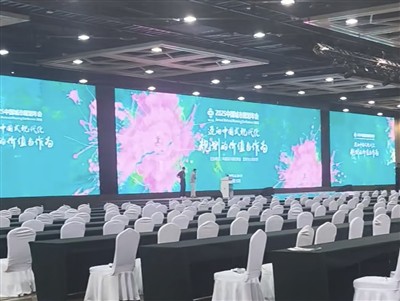
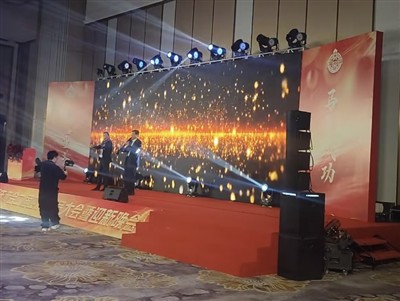
Advantages: Completely seamless, uniform picture; high brightness, strong resistance to ambient light; wide color gamut, high color saturation; suitable for long-distance viewing.
Disadvantages: Small-pitch (below P1.5) products still have slight graininess when viewed within 2 meters; may be glaring in high-brightness environments, requiring brightness reduction or the addition of an anti-glare mask.
Recommended Viewing Distance:
Viewing distance < 2.5 meters: Prioritize all-in-one LCD screens or small-pitch LED screens below P1.2 (higher cost).
Viewing distance 2.5-4 meters: P2.0 LED or LCD video wall are both suitable.
Viewing distance > 4 meters: P2.5 and above LEDs offer a significant advantage in seamless display.
III. Selection Decision Tree Make a quick decision by following these steps:
Required size: ≤100 inches → Choose an all-in-one LCD screen (conference panel); >100 inches → Proceed to the next step.
Viewing distance: Front row <3 meters → Requires small-pitch LED (P1.8 and below) or LCD video wall (pay attention to the seam); Front row >4 meters → Either LED or video wall is acceptable.
Seam allowance: Absolutely no black lines acceptable → Choose LED screen; 0.88mm thin lines acceptable → LCD video wall offers better value.
Budget: Tight budget but seams are acceptable → LCD video wall; Ample budget and a seamless display is desired → LED screen.
IV. Summary Large presentation screens (represented by LCD) and LED screens each have their advantages and disadvantages. There is no absolute "better" option, only "more suitable" one. Large display screens offer significant advantages in small to medium sizes (≤100 inches), close-range viewing, high-resolution requirements, and integrated smart experiences, making them the preferred choice for conference rooms, classrooms, and homes. LED screens, on the other hand, are irreplaceable in ultra-large sizes, seamless splicing, high-brightness environments, and long-distance viewing scenarios, making them the standard solution for lecture halls, exhibition halls, command centers, and outdoor advertising.
When actually selecting a screen, it is recommended to consider the specific dimensions of the conference room, the distance to the front row, the budget, and the frequency of use. If necessary, consult professionals for on-site simulations to make the optimal decision.