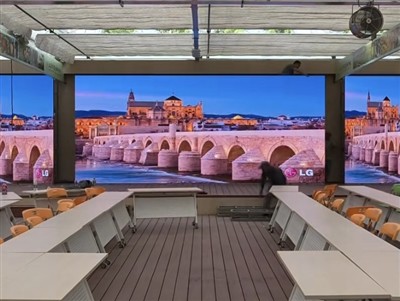
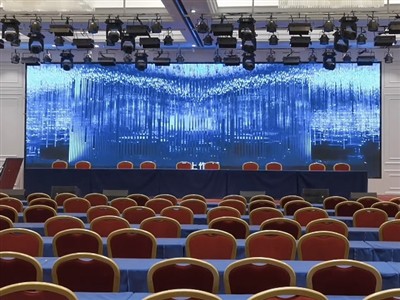
Why are P2.5 indoor full-color LED displays so popular in the current market?
The popularity of P2.5 indoor full-color LED displays in the current market is mainly due to their precise balance between image clarity and cost, and their wide adaptability to various scenarios. The specific reasons are as follows:
I. Display Effect: Balancing Clarity and Viewing Comfort
Resolution Adaptable to Close-Range Viewing: The P2.5 has a pixel pitch of 2.5mm, with a pixel density of approximately 160,000 pixels per square meter. At indoor viewing distances of 1-5 meters (such as shopping malls, conference rooms, and exhibition halls), the image is delicate and grain-free, with clarity superior to P3 (110,000 pixels/㎡), and offers better value for money than P1.875 (which costs over 50% more).
Balanced Color and Dynamic Performance: The RGB LEDs in the full-color LED display emit light independently, achieving a color gamut coverage of over 85% NTSC, resulting in true-to-life color reproduction. It supports refresh rates of over 1920Hz, eliminating flicker or moiré patterns during shooting, meeting the needs of live streaming, conference recording, and other scenarios.
Brightness adapts to indoor lighting environments: The adjustable brightness range is 400-1000 cd/m², ensuring clear visibility under natural daylight and allowing for lower brightness at night to avoid glare, thus solving the problem of blurry display in strong light environments common with traditional projectors.
II. Scene Adaptability: Covering Mainstream Indoor Application Needs
Commercial Display Scenarios: Curved or irregularly shaped screens in shopping mall atriums and brand flagship stores often utilize P2.5 modules. This allows for visual impact through large sizes (e.g., 10m x 5m) while ensuring clear details (e.g., clothing textures, cosmetic colors) when customers view advertisements at close range.
Government and Office Scenarios: Main screens or background walls in government conference rooms and corporate auditoriums need to balance "high-definition display in small spaces" with "no blind spots for multiple viewers." P2.5 screens support seamless splicing (seam < 0.5mm), avoiding the "black border" effect of LCD splicing screens, and support simultaneous display of multiple signal sources (e.g., PPT, videos, data charts). Cultural and Exhibition Scenarios: P2.5 screens are commonly used in interactive exhibits at museums and science and technology museums. Their fast response time (<1ms) is suitable for touch interaction and dynamic image switching, and combined with AR technology, they can create immersive experiences (such as 360° virtual artifact displays).
III. Cost and Maintenance: Significant Cost-Effectiveness Advantages
Controllable Procurement Costs: Compared to small-pitch (P1.5/P1.25) screens, P2.5 screens are 30%-50% cheaper per square meter, and their modules are highly standardized (commonly used by most manufacturers), resulting in lower replacement and maintenance costs. Compared to LCD splicing screens, although the initial investment is slightly higher, their lifespan (6-10 years) is 1.5 times that of LCDs, leading to lower long-term operating costs.
Flexible Installation and Maintenance: Magnetic or snap-on installation allows for module replacement by a single person; support for "point-by-point calibration" technology allows for individual calibration of local LED attenuation without replacing the entire screen, reducing maintenance downtime.
Balance between energy consumption and lifespan: The self-emissive nature of LEDs results in energy consumption that is only 60% of that of an LCD screen of the same size. They also have a wide operating temperature range (-10℃-50℃), operate stably in air-conditioned environments, and have a mean time between failures (MTBF) exceeding 50,000 hours.
IV. Mature Technology: Comprehensive Supply Chain and Solution Support
Standardized Production Reduces Risk: Major manufacturers have mature P2.5 product lines with strong module compatibility, allowing for flexible combinations into any size, avoiding the delivery delay risks associated with customized products.
Rich Supporting Solutions: From control systems to installation structures (curved, curved, suspended), mature solutions are available, supporting integration with sensors and AI systems (such as automatic brightness adjustment and overlay display of pedestrian flow data) to meet the needs of smart scenarios.
Summary: The P2.5 indoor full-color LED display precisely strikes a balance between clarity, cost, and scenario adaptability, offering superior display effects compared to lower-precision models (P3/P4) while lowering the barrier to entry for high-precision models (P1.875/P1.5), perfectly covering over 80% of indoor mid-to-high-end display needs. For users who prioritize "uncompromising image quality with a controllable budget," P2.5 becomes the "optimal solution" without any dilemma, thus continuing to dominate in scenarios such as shopping malls, conference rooms, and exhibition halls.