What are the differences between DLP large screens, LCD, and LED large screens?
In professional display fields such as command centers, monitoring halls, conference rooms, and outdoor advertising, DLP, LCD, and LED are three mainstream large-screen display technologies. Many non-professionals easily confuse them or choose based solely on price, resulting in a serious mismatch between display effects, maintenance costs, and actual needs. In fact, these three have fundamental differences in splicing principles, optical structures, gap control, brightness and color, and applicable scenarios. This article will start from the technical foundation to help you clearly understand the core differences between DLP, LCD, and LED large screens.
I. DLP Large Screens: Optical Cabinet Splicing, a Near-Seamless High-End Choice
DLP is an abbreviation for Digital Light Processing. Its core technology is the Digital Micromirror Device (DMD), exclusively provided by Texas Instruments. A DLP display unit is essentially an independent optical cabinet-containing a light source, DMD chip, color wheel (or RGB-LED light source), lens, and reflector. Multiple such cabinets are arranged in a matrix (e.g., 2×2, 3×4) and assembled into a complete large screen through a precision adjustment mechanism.
Seamless Joints: The physical seams of DLP large screens are extremely small, typically around 0.5 mm. At normal viewing distances (above 2 meters), this seam is almost invisible, hence it is often described as "near-seamless." Compared to the bezels of LCD large screens, which are several millimeters to centimeters wide, DLP offers a significant advantage when displaying a complete map, flowchart, or monitoring image on full screen.
Unit Size and Light Source: Individual DLP cabinets are relatively large, with common sizes including 50 inches, 60 inches, 67 inches, 80 inches, and even larger. This means that fewer cabinets are needed to build a large screen of the same area compared to an LCD video wall, thus reducing the workload of splicing adjustments. Regarding light sources, early models mostly used UHP (ultra-high pressure mercury lamps), which offered high brightness but had a short lifespan (approximately 6000-10000 hours), requiring regular bulb replacements. In recent years, high-end models have generally adopted LED light sources, with lifespans exceeding 60,000 hours and more stable colors, eliminating the maintenance hassle of frequent bulb replacements.
Display Effect and Market Positioning: DLP large screens offer advantages such as good brightness uniformity (brightness difference across the entire screen can be controlled within 10%), consistent color, no risk of burn-in, and support for 24/7 continuous operation. Therefore, they are mainly used in mid-to-high-end control and command centers, such as public security traffic police command halls, power grid dispatch centers, airport towers, and urban emergency response centers-places with stringent requirements for stability and image quality. Well-known brands include Barco, GQY, and Vtron, with relatively high system costs.
II. LCD Large Screens: The Mainstream of Monitoring with Noticeable Gaps from LCD Panel Splicing
LCD large screens are simply a spliced version of the familiar Liquid Crystal Display (LCD). It combines multiple standard industrial-grade LCD panels (typically 46-inch, 47-inch, 55-inch, or 60-inch) using a dedicated splicing bracket and processor. Each sub-screen is a complete LCD display, only with bezels designed to be as narrow as possible.
Splicing Gaps: This is the most obvious drawback of large LCD screens. Even the narrowest industrial-grade splicing screens currently available have a total seam between 3.5mm and 6.7mm after adding the physical bezel and sealing strips (early products even exceeded 10mm). This means that in a multi-LCD spliced image, there will be several obvious "cross" or "grid" black or bright lines running across the screen, severely disrupting the overall visual appeal. Therefore, large LCD screens are not suitable for scenarios primarily displaying full-screen images (such as a complete map or battle map), but are very suitable for monitoring scenarios with "multi-window independent display"-for example, displaying live feeds from 16 cameras simultaneously on a wall, where each feed's own bezel actually helps to distinguish areas.
Panel Brands and Market Status: The core LCD panels for large LCD screens mainly come from a few panel manufacturers such as Samsung, LG, Sharp, and BOE. However, there are hundreds or even thousands of companies selling LCD splicing screens on the market, most of which are "integrators" who purchase panels, driver boards, and metal casings and assemble them themselves, rather than true manufacturers. This leads to inconsistent product quality-some may use A+ grade panels, while others may use downgraded panels; some have good heat dissipation designs, while others are prone to blackouts or screen distortions in high summer temperatures. Therefore, when purchasing LCD large screens, the manufacturer's quality and reputation are more important than price.
Typical Applications: Due to their relatively low cost (compared to DLP) and good single-screen resolution, LCD large screens are mainly used in the low-to-mid-range monitoring market, such as community security monitoring rooms, supermarket monitoring centers, and school monitoring rooms-scenarios where gaps are not a major concern and budgets are limited.
III. LED Large Screens: Dot-Pitch Light Sources, High Brightness, Low Resolution-The King of Outdoors
LED large screens are completely different from the LED-backlit LCD screens we discussed earlier. It lacks a liquid crystal layer; instead, it uses thousands of red, green, and blue LED beads as pixels, arranged on modules and then spliced together to form a large-area display.
Pixel Pitch and Resolution: The core parameter of an LED screen is the pixel pitch (P-value), which is the distance between the centers of two adjacent pixels, measured in millimeters. P10 represents a pixel pitch of 10mm, and P3 represents 3mm. A smaller pixel pitch results in higher pixel density and resolution, but also a sharp increase in cost. Because the pixel pitch is typically above 3mm, the resolution of LED screens is relatively low, making them unsuitable for close-up viewing of fine text or images (a noticeable "graininess" can be seen within 2 meters). However, they offer extremely high brightness (5000-8000 cd/m² for outdoor models) and completely seamless splicing advantages.
Product Series: LED screens are divided into single/dual-color (which can only display single or dual-color text such as red, green, or yellow, commonly used for scrolling text on shop fronts) and full-color series (which can display full-color images and videos). The main difference in quality and price lies in the pixel pitch-a lower pixel pitch means more LED chips, a more complex driver IC, and a higher price.
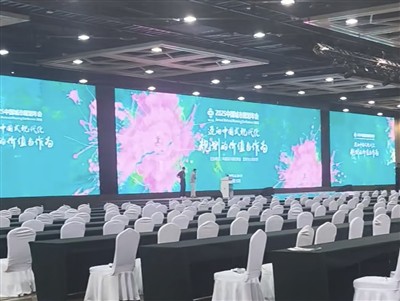
Applicable Scenarios: With its high brightness, waterproofing, weather resistance, and ability to be made in any large area, LED screens are primarily used in outdoor advertising media (such as building facade advertising screens and highway billboards) and indoor halls (such as central screens in stadiums and stage backdrops for large annual meetings)-environments where viewing distances are relatively far, resolution requirements are not high, but brightness and seamlessness are crucial.