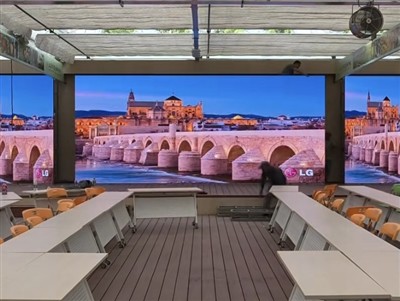
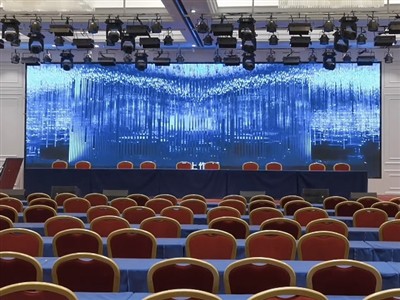
Large Display Screens for Conference Rooms
Currently, there are five main types of popular large-screen display products: projectors, LED displays, smart conference flat panels, LCD video walls, and seamless video walls. These are primarily used for displaying information during video conferencing, information presentations, and video playback.
I. Projectors
In the early days of conference rooms, projectors were a very common large-screen display product, and their affordability was a major factor in their popularity. However, their drawbacks include unclear projected images, generally insufficient brightness, and a relatively high failure rate. In strong light, the projected image becomes blurry. Therefore, projectors have gradually been phased out by other large-screen display products in recent years.
II. LED Displays
LED displays can achieve ultra-small pitches of up to 0.9mm. Their advantages mainly lie in seamless splicing, unlimited size splicing, and good image quality. However, they also have disadvantages. Due to their self-emissive display technology, prolonged viewing can be harmful to the eyes. Although unaffected by splicing seams, the image quality does not reach the high standards of LCD displays, and their price is relatively high.
III. Smart Conference Panels
Smart conference panels typically range in size from 65 to 100 inches, with resolutions up to 4K ultra-high definition. They offer a comprehensive range of functions, including remote video conferencing, wireless projection/two-way control, precise touch control/handwriting input, and more. Installation is simple; they can be wall-mounted or mounted on wheels for easy movement and use. However, size limitations are a drawback; currently, the largest size on the market is only 100 inches, which may appear small in large conference rooms.
IV. LCD Video Walls
LCD video walls were primarily used in video surveillance in the past. With ultra-narrow bezels (as low as 0.88mm), they provide a superior integrated display of large-screen images, making them ideal for offices and conference rooms. Their single-screen resolution reaches up to 1920p, resulting in clearer and brighter images. They are also stable, have a long lifespan, and are relatively inexpensive. Unlimited splicing is another major advantage; they can be arranged arbitrarily according to the specific needs of the office for more efficient and effective use.
V. Seamless Splicing Screens
Seamless splicing screens not only continue the high-standard display technology of LCDs, but also excel in splicing technology. Through optical refraction technology or LED electronic compensation technology, they eliminate the influence of black borders between splicing units, achieving a normal 0mm splicing display and presenting users with a seamless visual effect of large-screen splicing. In terms of price, it is not much different from LCD splicing screens, which is why it is widely favored by users.