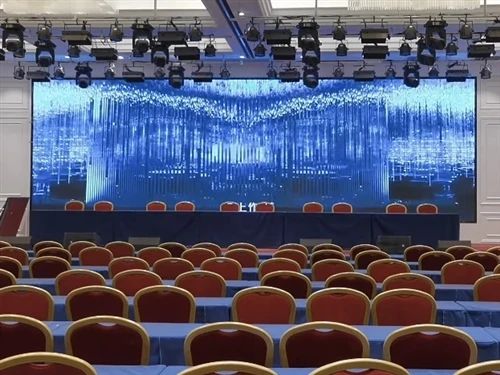
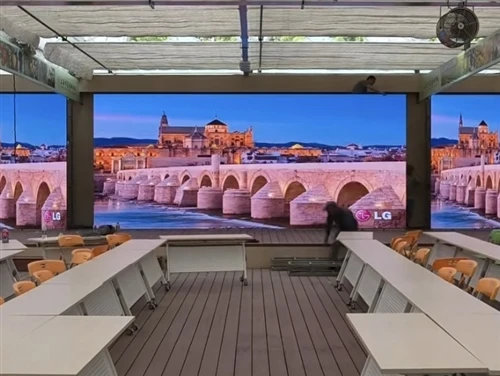
Currently, most LED displays are flat, while curved screens refer to LED splicing screens with a certain curvature.
Types of Curved LED Displays
Curved LED displays can be divided into inner curves, outer curves, circular curves, and elliptical curves.
Advantages and Benefits of Curved LED Displays
1. Aesthetics
Curved LED displays are more aesthetically pleasing than conventional LED displays, making them suitable for applications requiring personalization.
2. Space Saving
Due to the curved splicing, they occupy less space overall, which is advantageous for applications with multiple signal sources.
3. Better Viewing Experience
Curved LED displays offer a wider viewing angle and a better viewing experience.
Application Scenarios of Curved LED Displays
Curved screens are suitable for applications in commercial buildings, real estate construction projects, hotels, restaurants, and other similar locations.
Manufacturing and Installation of Curved LED Displays
The manufacturing and installation of curved LED displays are mainly achieved through curved LED cabinets. Curved LED display cabinets typically have their module mounting surfaces bent into polygonal planes with 4 to 6 bends. Square display modules are then placed on these bends, forming a near-curved display surface. Multiple curved unit cabinets are then combined to create a large-area curved LED display screen.
What is the ideal curvature for a curved LED display screen?
While the curvature of a curved splicing screen needs to be determined based on the specific site conditions, it is generally best to control the curvature at around 170-175 degrees for a more natural appearance.