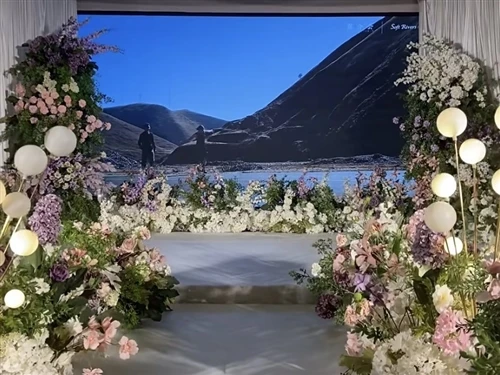
LED display leasing has emerged as a crucial visual medium for sporting events, press conferences, concerts, and exhibitions in the fast-paced world of event marketing. Compared to a one-time purchase, the rental model's affordability, adaptability, and expert operation and maintenance enable enterprises to create visually outstanding presentations. Based on real-world case studies and data tables, this article methodically examines every aspect of the LED display rental process, from definition and scenarios to benefits and technical solutions, to assist you in making well-informed decisions.
Notes on Technical Terminology
The center-to-center separation between neighbouring pixels, expressed in millimetres, is known as the pixel pitch (P-value). P3 denotes a pixel pitch of 3 mm; better resolution is indicated by a smaller value.
Cabinet: The smallest LED display installation unit, usually measuring 500 by 500 mm or 500 x 1000 mm, that makes splicing and transporting easier.
Grayscale: The brightness levels that each pixel can display, which influences how smoothly colours change; 12-bit to 16-bit is frequently employed.
Refresh Rate: The number of times the screen changes the image in a second; when captured by a camera, a refresh rate greater than 1920 Hz can avoid scan lines.
A Comprehensive Guide to Renting LED Displays: An Expert Guide from Definition to Execution
I. Definition and Fundamentals of Renting LED Displays
1.1 What is a rental LED display?
A short-term service that includes display equipment, structural setup, control system, and on-site technical support is referred to as LED display rental. Customers simply need to pay daily or weekly fees to acquire large-size, high-brightness, irregularly shaped splicing display solutions that are customized to their event demands; they do not have to invest millions of yuan in procurement expenditures.
1.2 The Rental Model's Fundamental Competitiveness
Zero Asset Depletion: Reduces single-event expenses by 60% to 80% by preventing equipment idleness.
Technology Generation Updates: To guarantee that customers always have access to the newest display technology, rental companies frequently upgrade popular cabinets like P2.5 and P3.9.
End-to-End Service: This service frees up the time and effort of the event planner by taking care of emergency backup screens, video processor troubleshooting, platform setup, and transportation.
II. Common Application Scenarios: Which events require rental LED screens to run?
| Scene type | Examples of common requirements | Recommended pixel pitch | Brightness requirements (nits) |
| Large concerts/music festivals | Main screen + side screen + floor tile screen, wind and rain resistant, quick assembly and disassembly. | P3.9-P5.9 | ≥5000 (outdoor) |
| Corporate press conference/annual meeting | Curved or right-angle stitching, high refresh rate meets the needs of live streaming shooting. | P2.5-P3.9 | 1500-2500 |
| Exhibition/Pop-up Store | Slim and lightweight front maintenance enclosure with irregular shapes (cylinder, cube). | P1.9-P2.5 | 1000-1500 |
| Sports events/outdoor advertising | High brightness and anti-glare, redundant power supply, supports multi-window split-screen. | P4-P6 | ≥5500 |
III. Five Core Advantages of LED Display Screen Rental (with Cost Comparison Table)
3.1 Significantly Reduced Budget for Single Events
The following example compares the TCO (Total Cost of Ownership) of purchasing versus renting a 200㎡ outdoor P3.9 screen used for 3 days:
| Cost items | Procurement Model (Ten Thousand Yuan) | Leasing model (ten thousand yuan) | explanation |
| Equipment purchase cost | 68 | 0 | P3.9 outdoor screen includes cabinet, power supply, and sending card. |
| Steel Structure and Transportation | 8 | Included in rent | Rental companies provide standard aluminum profile quick-installation racks. |
| Site Engineer (3 days) | 0.9 | Include | The lessee provides two technical personnel. |
| Spare modules and repair tools | 2 | Include | 5% spare boards are kept on site. |
The leasing model directly saves 92% of the cash investment and eliminates the risk of damage during transportation.
3.2 Adaptable Reaction to Intricate Locations and Creative Requirements
Curved/Irregular Shape Splicing: Cylindrical and ribbon screens can be built using rental cabinets that support -10° to +10° arc locking.
Quick Delivery: In only four to six hours, a skilled crew can install and commission a 200-square-foot outdoor screen.
Unified Standard Control for Several Brands: To achieve primary and secondary screen frame synchronization, the rental company provides cascade solutions for control systems like Nova and Lingxingyu.
IV. Expert Rental Options and Technical Details
4.1 Selection Guide: How Can Pixel Pitch and Viewing Distance Be Matched?
The suggested minimum viewing distance (meters) ≈ pixel pitch (mm) × 1.5 is based on the resolution limit of the human eye.
Indoor Premium Launch Events: Select a P2.5 or P1.9 high-definition LED rental screen that can be viewed from three to eight meters away.
Outdoor Large-Scale Events: P4 or P5.9, guaranteeing heat dissipation and brightness at a viewing distance of 6–15 meters.
An example of a long-tail term is the choice of pixel pitch for high-definition LED rental screens, which has a direct impact on the ratio of cost to visual detail.
4.2 Outdoor Protection and Structural Safety Solution
Wind Resistance: Diagonal bracing that is stable even in level 9 winds is required for outdoor rentals. The rain shelter, drainage channels, and IP65 protective shell are all part of the rainproof outdoor LED rental screen solution.
Power Supply Redundancy: An independent three-phase power supply and a backup generator switch are needed, with a calculation of 300W per square meter.
4.3 Control System Optimization and Content Adaptation
Video Processor: Fade-in/fade-out switching, arbitrary splicing, and 4K input are all supported.
HDR Effect: When paired with other characteristics, the rental screen's brightness and grayscale levels can display high dynamic range content that is appropriate for automobile launches.
V. Actual Case: An International Auto Show's Outdoor LED Rental Screen Project
Background: In order to display its electric car models at the 2024 Guangzhou Auto Show, a German luxury company had to construct a 12-meter-diameter circular "halo screen" and a 150-square-foot interactive floor tile screen. The location was an outdoor exhibition space that was subject to strong winds and rain, as well as the outer bands of a typhoon. The entire process, from arrival to delivery, has to be finished in three days.
Solution (carried out by a top rental company):
Selection: P3.9 outdoor rental screens with curved locks that allowed for circular assembly and 15° bending were utilized. For the floor tiles, P6.25 high-load-bearing, light-transmitting screens were chosen.
Rainproof Structure: A 2-meter rain cover was extended from the top and airflow channels were added to the back of the screens. IP67 aviation plugs were utilized in all connectors.
Rainy Setup: In about 22 hours, 18 professionals finished the steel framework, screen mounting, and wiring using pre-assembled modules.
Content Adaptation: Four 4K servers were cascaded to provide real-time interaction between the circular screens and the floor tile screens (such as vehicle wraparound animations).
Results: Over 100,000 people interacted with the screens during the event, which saw zero malfunctions despite 80mm/h of severe rain. The client renewed for all auto show projects for the upcoming year since the temporary event LED screen rental setup time was 30% less than the industry norm.
VI. Common Questions (FAQ)
Q1: How is the cost of renting an LED display screen typically determined?
A: The screen cabinet, structure, delivery card, cables, and labour for setup and disassembly are all included in the "RMB/square meter/day" quote. A P2.5 indoor screen often costs 200–350 RMB, whereas a P3.9 outdoor screen typically costs 300–500 RMB. The length of the rental (discounts are offered for three days or longer), the distance travelled, and whether or not a video processor is included all have an impact on the cost of renting an LED screen.
Q2: How can we make sure there are no colour blocks or dead pixels on the screen?
A: Expert rental firms will carry 5% extra modules and hot-swappable equipment and do aging testing (white balance, grayscale gradient, 24-hour continuous playback) 72 hours beforehand. Every cabinet's voltage and temperature will be continuously monitored by engineers.
Q3: How long is the minimum renting period? How is activity during the night charged?
A: The majority of suppliers charge for a minimum of one day (8 hours of use), with extra hours beyond four hours being billed as half a day. There will be extra electrical and staffing costs (about +20%) for midnight events that need overnight screen illumination.
Q4: When renting an LED screen, do I have to supply my own video signal source?
A laptop, camera, or media server is an example of an HDMI/DP/SDI signal source. In addition to a video processor and a minimum 10-meter fibre optic HDMI connection, the rental provider will help establish the resolution (e.g., 1920x1080 or point-to-point splicing).
Q5: How can I assess a rental company's credentials and dependability?
A: Make the following request: ① Actual footage of comparable situations that took place in the previous six months; ② Certificates of original manufacturer authorization from popular companies (such as Leyard, Unilumin, and Absen); ③ A public liability insurance policy that covers up to one million RMB. To evaluate equipment turnover and deteriorating laboratory conditions, it is best to visit their warehouse.