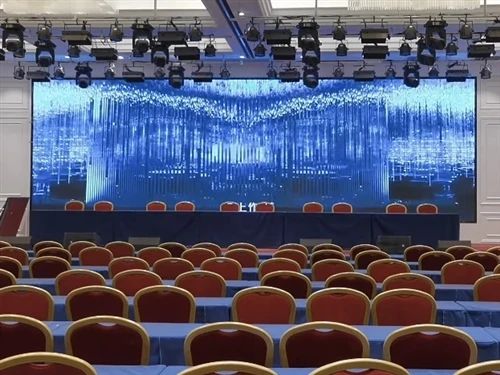
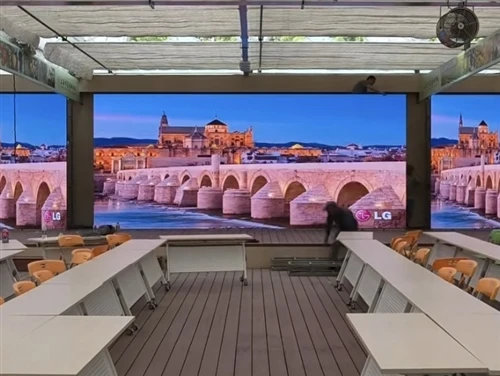
Simply put, an LED display screen is composed of several combinable display units (unit display boards or unit display cabinets) that form the screen body, plus a set of appropriate controllers (main control board or control system). Therefore, various specifications of display boards (or unit cabinets) combined with controllers using different control technologies can form many types of LED display screens to meet the needs of different environments and display requirements.
A detailed breakdown of an LED display screen reveals the following components (taking a more complex synchronous video screen as an example):
I. Metal Structure Frame
Indoor screens generally consist of a metal support frame, carrying various circuit boards such as display boards and switching power supplies. The outer frame uses aluminum alloy square tubes, or aluminum alloy clad stainless steel, or is made of integrated sheet metal.
The inner frame of outdoor screens is a metal waterproof box structure. The outer frame, depending on the screen size and load-bearing capacity, is generally made of angle steel or I-beams, and the outer frame can be decorated with aluminum composite panels.
II. Display Unit
This is the main part of the display screen, composed of luminous materials and driving circuits. Indoor screens use various specifications of unit display boards, while outdoor screens use unit cabinets.
III. Scanning Control Board
This circuit board's function is data buffering, generating various scanning signals and duty cycle grayscale control signals.
IV. Switching Power Supply
Converts 220V AC power into various DC voltages to supply power to various circuits.
V. Twisted-Pair Transmission Cable
The display data and various control signals generated by the main control system are transmitted from the computer to the screen body via twisted-pair cables.
VI. Main Control System
Buffers, performs grayscale conversion, and reorganizes the input RGB digital video signals, and generates various control signals.
VII. Dedicated Display Card and Multimedia Card
In addition to the basic functions of a computer display card, it also outputs digital RGB signals and horizontal, vertical, and blanking signals to the main controller. In addition to the above functions, the multimedia card can also convert the input analog video signal into a digital RGB signal (i.e., video capture).
VIII. Computer and Peripherals
IX. Other Information Sources
Televisions, DVD/VCD players, video cameras, and switching matrices, etc.